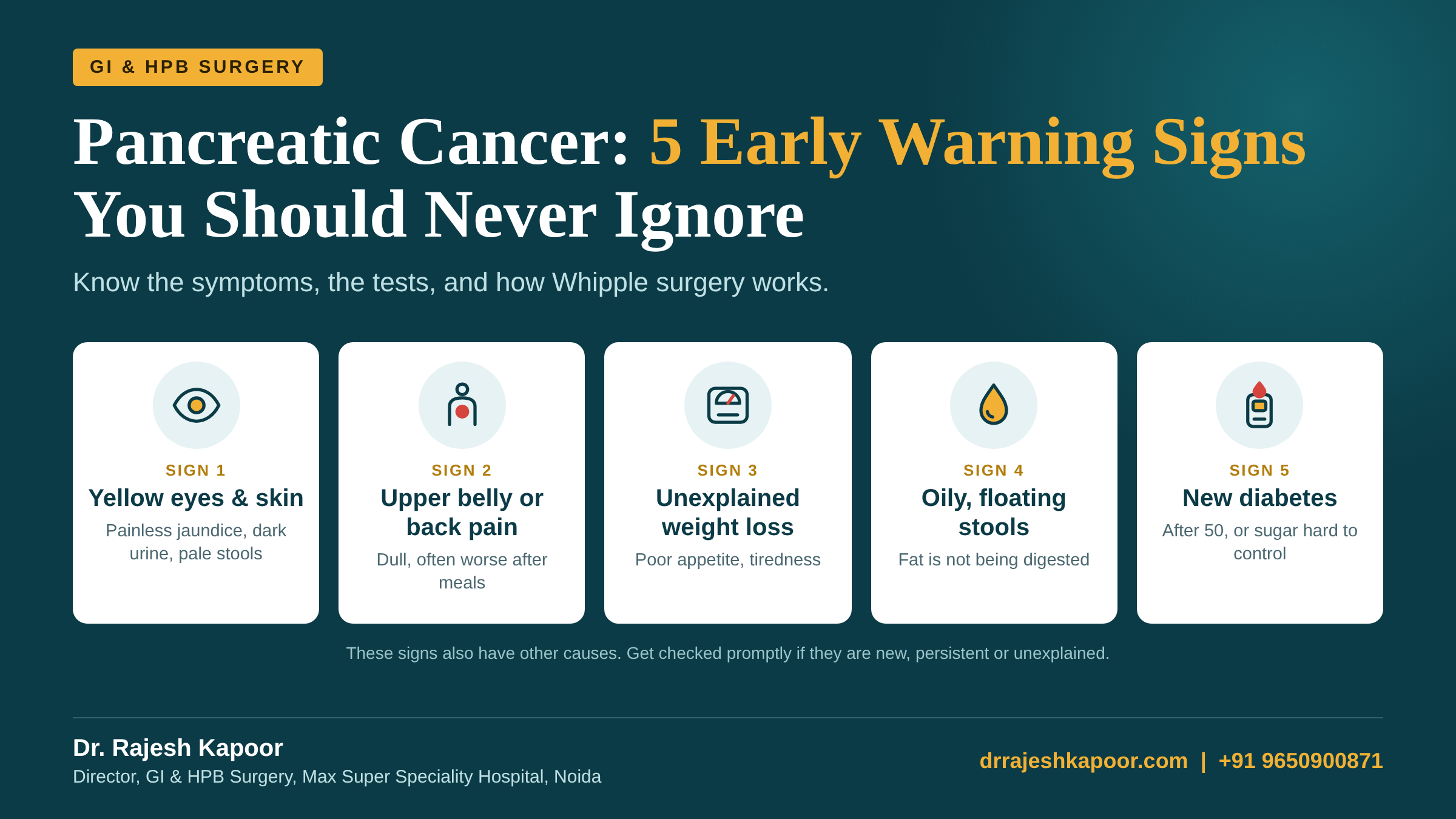
Pancreatic cancer is often found late. The reason is simple: the pancreas is hidden deep inside your belly, behind the stomach, so a small lump (tumour) rarely gives clear signs. That is why it helps to know the early warning signs. When the cancer is found early, surgery can give a real chance of long-term control.
What does the pancreas do?
The pancreas is a small organ behind your stomach. It does two jobs:
- It makes juices that help you digest food, especially fats.
- It makes insulin, which keeps your blood sugar under control.
Pancreatic cancer symptoms: 5 warning signs
Very early pancreatic cancer often causes no symptoms. When symptoms do appear, these are the most common:
- Yellow eyes and skin (jaundice). You may also see dark urine, pale stools and itching. This happens when the lump blocks the tube (bile duct) that carries bile out of the liver. It is often painless.
- Pain in the upper belly or back. A dull ache that may get worse after meals or when lying flat.
- Weight loss without trying, with poor appetite and tiredness.
- Oily, smelly stools that float. Your body is not digesting fat properly.
- New diabetes, especially after age 50, or blood sugar that suddenly becomes hard to control.
Most people with these problems do not have pancreatic cancer. Gallstones, hepatitis, ulcers and acidity cause many of them. But do not just wait and watch. If a symptom is new, lasts more than a couple of weeks, or has no clear reason, see a doctor.
If you notice yellow eyes, read our guide on medical vs surgical jaundice.
Who is at higher risk?
- People who smoke or chew tobacco
- People with long-term swelling of the pancreas (chronic pancreatitis)
- People with diabetes, especially new diabetes after 50
- People who are overweight, or who drink a lot of alcohol
- Anyone over 60
- People whose close family members had pancreatic cancer
Having a risk factor does not mean you will get cancer, and some people with cancer have none. You can control some risks. Read how alcohol and smoking affect your digestive tract.
How do doctors find out?
Doctors use a few simple steps:
- Blood tests to check your liver and your blood sugar.
- CT scan or MRI scan. These take detailed pictures of the pancreas and show whether the lump can be removed by surgery.
- Endoscopic ultrasound. A thin tube with a tiny camera goes in through the mouth to look closely at the pancreas. A small piece of the lump can be taken for testing (biopsy).
Sometimes a blood test called CA 19-9 is used. It helps during follow-up, but it cannot confirm cancer on its own.
Can pancreatic cancer be treated?
Yes. The treatment depends on how far the cancer has grown.
| How far has it grown? | Usual treatment |
|---|---|
| Early, and the lump can be removed | Surgery, usually along with chemotherapy (cancer medicines) |
| Growing close to important blood vessels | Chemotherapy first to shrink the lump, then surgery if it becomes possible |
| Spread to other organs | Chemotherapy and care to ease symptoms and keep you comfortable |
Surgery is the only treatment that can cure pancreatic cancer. Only some patients can have surgery when the cancer is first found, which is why seeing a specialist early matters.
Treatment is planned by a team: a surgeon, a cancer specialist, a radiologist and a nutrition expert, working together.
What is Whipple surgery?
Whipple surgery is the main operation for cancer in the head of the pancreas, the wide part next to the small intestine. The surgeon removes:
- the head of the pancreas
- the first part of the small intestine
- the gallbladder
- part of the bile duct
- sometimes, a small part of the stomach
The surgeon then joins the remaining parts together again, so that food, bile and pancreatic juice can flow normally.
The operation takes several hours, and you are fully asleep (general anaesthesia). It can be done through one larger cut, or, in selected patients, with key-hole or robotic surgery that uses small cuts. Read more about robotic surgery in cancer treatment. If the lump is in another part of the pancreas, a different operation is used.
Is Whipple surgery risky?
It is a big operation, so it carries real risks. These include:
- leaks from the joins inside the belly
- bleeding or infection
- slow emptying of the stomach, which causes nausea and a slow return to normal food
- new or worse diabetes
Most problems can be treated if they are found early. The experience of the surgeon and the hospital matters a lot. Choose a hospital that does this surgery regularly and has intensive care and other specialists on site. It is fine to ask your surgeon how often they do it.
Recovery after Whipple surgery
- Hospital stay is usually about one to two weeks.
- You start walking within the first few days.
- Food is restarted slowly, first liquids, then soft food.
- At home, you eat small meals many times a day.
- Getting your strength back takes a few weeks to a few months.
- You will need regular check-ups. If chemotherapy is advised, it usually starts a few weeks after surgery.
Every patient is different, so your doctor will give you a plan for your case.
Living after pancreatic surgery
- Eat small, frequent meals with enough protein.
- Take enzyme capsules with meals if your doctor prescribes them. They help your body digest food.
- Check your blood sugar as advised.
- Weigh yourself once a week and tell your doctor if you keep losing weight.
- Do not drink alcohol or use tobacco.
- Call your doctor if you have fever, repeated vomiting, a red or leaking wound, or yellow eyes.
For more on eating after an abdominal operation, read Diet After Gastrointestinal Surgery.
When should you see a doctor?
See a stomach and liver (GI and HPB) surgeon without delay if you have:
- yellow eyes or skin, dark urine or pale stools
- upper belly or back pain that does not settle in a couple of weeks
- weight loss with no clear reason
- new diabetes after 50, or sugar that is suddenly hard to control
- close family members with pancreatic cancer
Do not wait for pain. Early checking is what makes surgery possible.
Frequently asked questions
What are the first signs of pancreatic cancer? Yellow eyes and skin, a dull ache in the upper belly or back, weight loss, oily stools and new diabetes. Many of these have other causes, so get checked.
Can pancreatic cancer be cured? Surgery is the only treatment that can cure it, and it works best when the cancer is found early. Your doctor can tell you what to expect in your own case.
What is Whipple surgery used for? It is used for cancer in the head of the pancreas. It is also used for some cancers of the bile duct and the first part of the small intestine.
How long does Whipple surgery take? The operation takes several hours. Most people stay in hospital for about one to two weeks, and getting back to normal energy takes a few months.
Is Whipple surgery safe? It is a major operation with real risks, but most patients recover well at hospitals with an experienced team. Your general health also matters.
Can I live a normal life after Whipple surgery? Many people return to everyday life. Some need enzyme capsules, diet changes or diabetes treatment, and regular check-ups are important.
Which doctor treats pancreatic cancer in Noida? You can consult Dr. Rajesh Kapoor, Director and Head of GI & HPB Surgery at Max Super Speciality Hospital, Sector 128, Noida, who has more than 30 years of experience. See also HPB Surgical Interventions and Surgical Oncology for GI Cancers.
Book a consultation
If you or someone in your family has yellow eyes, pain in the upper belly or back, or weight loss with no reason, getting checked early can change the treatment options. Consult Dr. Rajesh Kapoor at Max Super Speciality Hospital, Jaypee Hospital Road, Sector 128, Noida. Call +91 9650900871 or use the appointment form on this website.
This article is for general education and is not a substitute for medical advice. Yellow eyes or severe belly pain need prompt medical attention.