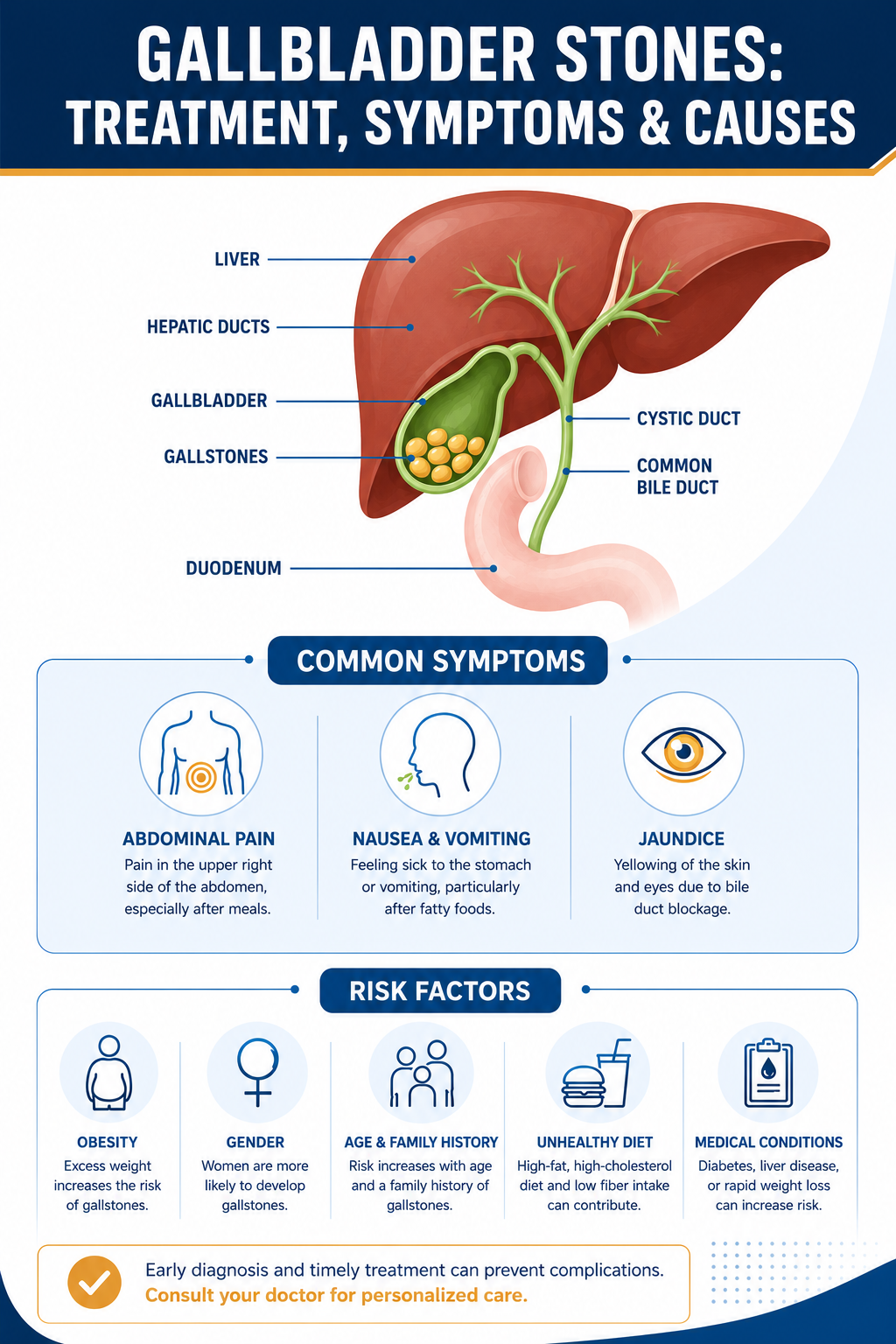
If you have ever felt a sharp, cramping pain under your right ribs after a heavy meal, gallstones could be the reason. This guide covers gallbladder stones treatment options, from diagnosis to surgery. Gallstones are one of the most common digestive problems seen in India today, and for many patients, surgery is the only lasting solution.

As a GI and HPB surgeon who has performed thousands of gallbladder procedures over three decades, Dr. Rajesh Kapoor explains what gallstones are, why they form, and how modern laparoscopic surgery makes treatment safer and faster than ever.
What Are Gallbladder Stones?
The gallbladder is a small, pear-shaped organ under the liver that stores bile, a fluid that helps digest fat. Gallstones are hard deposits that form inside the gallbladder when substances in bile, mostly cholesterol or bilirubin, crystallize. These stones can range from as small as a grain of sand to as large as a golf ball, and a person may have just one stone or several at once.
What Causes Gallstones?
Several factors increase the risk of developing gallstones, including:
- Excess cholesterol in bile – when the liver produces more cholesterol than bile can dissolve
- Obesity and rapid weight loss – both disturb the balance of bile chemicals
- Diet – high in fat and refined carbohydrates, low in fiber
- Family history – a genetic tendency toward gallstone formation
- Age and gender – more common over 40, and in women
- Diabetes and metabolic conditions
- Prolonged fasting or irregular eating habits
Common Symptoms of Gallstones

Many people carry gallstones without knowing it, but when a stone blocks a bile duct, it can cause a gallbladder attack. Watch for:
- Sudden, intense pain in the upper right or center of the abdomen
- Pain that spreads to the right shoulder or back
- Nausea or vomiting, especially after fatty meals
- Bloating and indigestion
- Fever and chills (possible infection or inflammation)
- Yellowing of the skin or eyes (jaundice) – needs urgent evaluation
According to the National Institute of Diabetes and Digestive and Kidney Diseases, gallstones are a common digestive problem.
- Ultrasound of the abdomen – the first and most reliable test
- Blood tests – check for infection or liver involvement
- MRCP or CT scan – for closer evaluation of the bile ducts
- Endoscopic ultrasound (EUS) – for smaller or borderline stones
Gallbladder Stones Treatment: Do All Gallstones Need Surgery?
Not every gallstone requires immediate surgery. Small, silent stones are often simply monitored. Surgery is generally recommended when stones cause repeated pain, inflammation, blockage, or when the patient has diabetes, since infections can progress faster.
Medications to dissolve stones work slowly, only for specific stone types, and stones often recur. For this reason, surgical removal of the gallbladder remains the most effective, permanent treatment.
Laparoscopic Cholecystectomy: The Modern Standard of Care

Gallbladder removal today is rarely the large, open surgery it once was. Laparoscopic cholecystectomy is now the gold standard worldwide and the approach Dr. Kapoor uses for the vast majority of his patients.
How It Works
Instead of one large incision, the surgeon makes 3–4 small keyhole incisions in the abdomen. A thin camera (laparoscope) and specialized instruments are inserted through these openings to carefully detach and remove the gallbladder.
Why Laparoscopic Surgery Is Preferred
- Minimal scarring – small incisions instead of a large cut
- Less pain compared to open surgery
- Shorter hospital stay – most go home within 24–48 hours
- Faster recovery – light activity within a week
- Lower risk of infection due to smaller wounds
Recovery After Gallbladder Surgery
- Day 1–2: Discharge in most uncomplicated cases
- Week 1: Light walking; avoid heavy lifting
- Week 2: Most resume desk jobs and daily routines
- 4–6 weeks: Return to strenuous exercise

About Dr. Rajesh Kapoor
GI & HPB Surgeon with over three decades of experience in laparoscopic and advanced GI surgery.
Experiencing symptoms of gallstones? Get evaluated by an experienced GI surgeon.
Book an AppointmentFrequently Asked Questions
Can gallstones go away on their own?
Small, silent stones sometimes remain harmless for years, but they don’t dissolve on their own in most cases. Regular monitoring with ultrasound is recommended.
Is life normal after gallbladder removal?
Yes. The liver still produces enough bile for digestion. Most people eat normally within a few weeks, though some prefer smaller, less fatty meals initially.
How long does laparoscopic gallbladder surgery take?
The procedure itself usually takes 30 to 60 minutes. Most patients go home within a day or two of surgery.
What foods should be avoided before gallbladder surgery?
Fried, fatty, and heavily processed foods can trigger gallbladder attacks and should be limited in the days leading up to surgery. Your doctor will give specific fasting instructions before the procedure.
This article is for general information and does not replace a consultation with a qualified surgeon. If you are experiencing severe abdominal pain, fever, or jaundice, seek medical attention promptly.