- Satyam Kapoor
- 0 Comments
Laparoscopic and Robotic GI Surgery: A Modern Approach to Safer, Faster Recovery
The field of gastrointestinal (GI) surgery has advanced significantly over the last few decades. Traditional open surgeries, which often required large incisions and lengthy recovery periods, are increasingly being replaced by minimally invasive techniques. Among the most effective of these are laparoscopic and robotic GI surgeries, which offer greater precision, reduced pain, and faster healing.
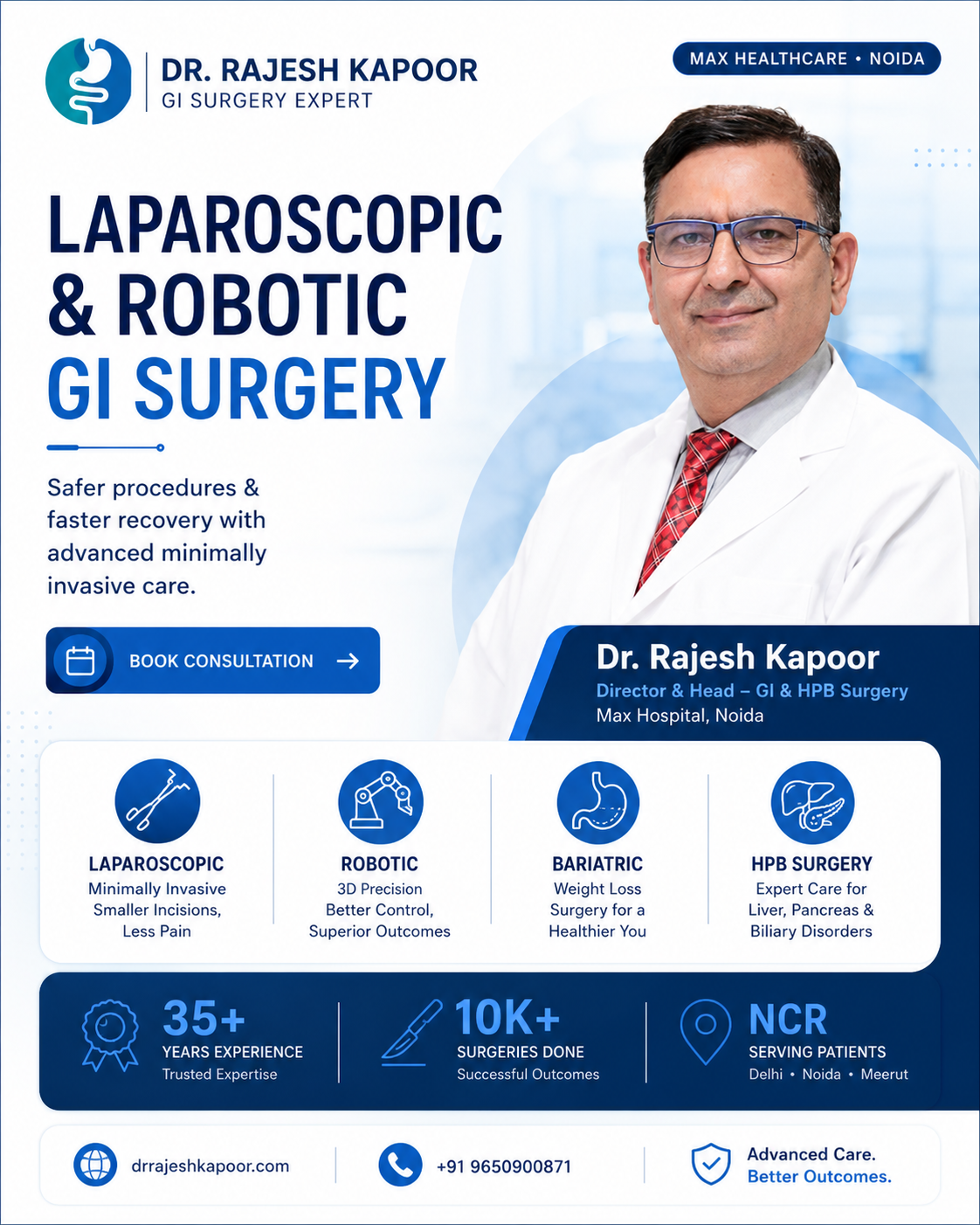
With over 35 years of surgical experience, Dr. Rajesh Kapoor, Director & Head of GI & HPB Surgery, Bariatric & Metabolic Surgery at Max Hospital, Noida, has been at the forefront of advanced gastrointestinal surgical care. His expertise in laparoscopic and robotic surgery enables patients to receive world-class treatment using the latest surgical technologies.
What is Laparoscopic GI Surgery?
Laparoscopic GI surgery is a minimally invasive surgical technique used to diagnose and treat disorders affecting the digestive system. Instead of making a large incision, surgeons perform the procedure through several small incisions using a laparoscope-a thin tube equipped with a high-definition camera-and specialized surgical instruments.
The camera provides a magnified view of the internal organs, allowing surgeons to perform complex procedures with remarkable accuracy while minimizing damage to surrounding tissues.
Benefits of Laparoscopic Surgery
- Smaller incisions
- Less postoperative pain
- Minimal blood loss
- Lower risk of infection
- Shorter hospital stay
- Faster recovery
- Minimal scarring
- Quicker return to normal activities
Robotic GI surgery is an advanced form of minimally invasive surgery that utilizes a sophisticated robotic surgical system controlled entirely by the surgeon. The robotic platform enhances precision through:
- High-definition 3D visualization
- Wristed instruments with greater flexibility
- Enhanced dexterity
- Superior precision during delicate procedures
- Improved access to difficult anatomical areas
It is important to understand that the robot does not perform the surgery independently. Every movement is directed by the surgeon, allowing for exceptional control and surgical accuracy.
Conditions Treated with Laparoscopic and Robotic GI Surgery
Advanced minimally invasive surgery is commonly recommended for several gastrointestinal disorders, including:
- Gallbladder stones and gallbladder disease
- Hernias
- Appendicitis
- Colorectal cancer
- Colon polyps requiring surgery
- Gastroesophageal Reflux Disease (GERD)
- Gastric cancer
- Liver tumours
- Pancreatic disorders
- Obesity requiring bariatric surgery
- Diverticular disease
- Inflammatory bowel disease (IBD)
Types of Laparoscopic and Robotic GI Surgeries
1. Laparoscopic/Robotic Cholecystectomy
This procedure involves the removal of the gallbladder, typically due to gallstones or chronic inflammation. It is one of the most commonly performed minimally invasive surgeries and usually allows patients to return home within 24 hours.
2. Laparoscopic/Robotic Hernia Repair
Hernias occur when internal tissues push through weakened muscles. Minimally invasive hernia repair offers:
- Smaller scars
- Reduced pain
- Faster recovery
- Lower recurrence rates in selected cases
3. Laparoscopic/Robotic Colectomy
A colectomy involves removing part or all of the colon. It is commonly performed for:
- Colon cancer
- Diverticulitis
- Ulcerative colitis
- Crohn’s disease
- Large benign polyps
Robotic assistance can improve precision during complex colorectal procedures.
4. Robotic-Assisted Colorectal Surgery
Robotic colorectal surgery is particularly beneficial in pelvic surgeries where space is limited. Enhanced precision helps preserve surrounding nerves and tissues while improving surgical outcomes.
5. Laparoscopic/Robotic Fundoplication
Fundoplication is performed to treat chronic acid reflux (GERD) when medications fail to provide long-term relief.
The procedure strengthens the valve between the oesophagus and stomach, reducing acid reflux and improving quality of life.
6. Laparoscopic Appendectomy
Acute appendicitis requires prompt surgical removal of the appendix. Laparoscopic appendectomy provides:
- Faster recovery
- Less pain
- Reduced wound complications
- Minimal scarring
7. Robotic/Laparoscopic Liver and Pancreatic Surgery
Liver and pancreatic surgeries are among the most complex gastrointestinal procedures.
Robotic technology helps surgeons perform these delicate operations with greater accuracy while preserving healthy tissues whenever possible.
8. Laparoscopic/Robotic Gastric Bypass and Sleeve Gastrectomy
These bariatric procedures help individuals with severe obesity achieve sustainable weight loss while improving obesity-related conditions such as:
- Type 2 diabetes
- High blood pressure
- Sleep apnoea
- Fatty liver disease
Who is a Candidate for Minimally Invasive GI Surgery?
You may be a suitable candidate if you have been diagnosed with:
- Gallstones
- Hernia
- Colon or rectal cancer
- GERD
- Obesity requiring bariatric surgery
- Appendix inflammation
- Liver or pancreatic tumours
- Certain inflammatory bowel conditions
The decision depends on your overall health, medical history, and the complexity of your condition. An experienced GI surgeon will determine the most appropriate surgical approach.
Advantages of Choosing Advanced Minimally Invasive Surgery
Compared with conventional open surgery, laparoscopic and robotic procedures offer several advantages:
- Smaller incisions
- Reduced postoperative discomfort
- Faster healing
- Lower risk of complications
- Reduced blood loss
- Better cosmetic results
- Earlier return to work
- Improved patient satisfaction
Why Choose Dr. Rajesh Kapoor?
With a distinguished career spanning more than 35 years, Dr. Rajesh Kapoor is among India’s leading experts in Gastrointestinal (GI), Hepatopancreatobiliary (HPB), Bariatric, and Metabolic Surgery.
As the Director & Head of GI & HPB Surgery and Bariatric & Metabolic Surgery at Max Hospital, Noida, he has successfully managed thousands of complex surgical cases using advanced laparoscopic and robotic techniques.
His areas of expertise include:
- Advanced GI Surgery
- Robotic Surgery
- Laparoscopic Surgery
- HPB Surgery
- Colorectal Surgery
- Liver Surgery
- Pancreatic Surgery
- Bariatric Surgery
- GI Oncology
Patients benefit from evidence-based treatment, modern technology, and comprehensive pre- and post-operative care.
Recovery After Laparoscopic and Robotic Surgery
Recovery varies depending on the type of surgery performed, but most patients experience:
- Less postoperative pain
- Shorter hospital stays
- Faster mobility
- Earlier return to daily activities
- Lower risk of wound complications
Following your surgeon’s instructions regarding diet, activity, medications, and follow-up appointments is essential for optimal recovery.
Frequently Asked Questions (FAQs)
1. What is the difference between laparoscopic and robotic surgery?
Laparoscopic surgery uses specialized instruments and a camera inserted through small incisions. Robotic surgery uses a robotic system controlled entirely by the surgeon, providing enhanced precision, flexibility, and 3D visualization.
2. Is robotic surgery safer than open surgery?
For many suitable patients, robotic surgery offers advantages such as smaller incisions, reduced pain, lower blood loss, shorter hospital stays, and quicker recovery compared to traditional open surgery.
3. Are laparoscopic surgeries painful?
Most patients experience significantly less pain compared to open surgery because only small incisions are made.
4. How long does recovery take after laparoscopic GI surgery?
Recovery depends on the procedure, but many patients resume normal activities within one to three weeks, while full recovery may take several weeks.
5. Which GI conditions can be treated using robotic surgery?
Robotic surgery is commonly used for colorectal disorders, hernias, GERD, gallbladder disease, liver surgery, pancreatic surgery, gastric surgery, and bariatric procedures.
6. Will I have visible scars after laparoscopic surgery?
The incisions are very small, resulting in minimal scarring compared to traditional open surgery.
7. Is robotic surgery performed by a robot alone?
No. The robotic system never operates independently. Every movement is controlled by the surgeon, ensuring maximum precision and safety.
8. How do I know if I am a candidate for laparoscopic or robotic GI surgery?
A detailed consultation, physical examination, imaging studies, and medical evaluation by an experienced GI surgeon will determine the most suitable surgical approach based on your condition.
Conclusion
Laparoscopic and robotic GI surgery represent the future of gastrointestinal care by combining advanced technology with surgical expertise. These minimally invasive techniques provide safer procedures, quicker recovery, and improved outcomes for patients suffering from a wide range of digestive disorders.
If you are experiencing gastrointestinal problems that may require surgery, consulting an experienced GI surgeon can help determine the most appropriate treatment plan. Early diagnosis and timely intervention often lead to better outcomes and improved quality of life.