- Dr. Kapoor
- 0 Comments
A Patient’s Guide to a Smooth Journey from Hospital to Healing
Surgery can be scary. 😟 Even the word makes some people anxious. But when it comes to gastrointestinal (GI) surgery—whether it’s for a hernia, gallbladder, or colorectal condition—knowing what to expect can make all the difference. 🧘♀️✨
This guide will walk you through everything from pre-surgery prep to post-surgery recovery, giving you confidence, clarity, and peace of mind. Let’s demystify the process! 👇
🔍 What Is GI Surgery, and When Do You Need It?
GI surgery addresses problems in the digestive system, including the stomach, intestines, colon, rectum, liver, gallbladder, and more.
🔹 Common types of GI surgery:
- Hernia repair
- Gallbladder removal (cholecystectomy)
- Appendix removal
- Colorectal surgery (for cancer, polyps, or diverticulitis)
- Anti-reflux surgery
You may need surgery if you have persistent pain, digestive issues, or a serious condition that medication can’t treat.
🧼 Before Surgery: Preparing Your Body & Mind
✅ 1. Medical Evaluation
Before your surgery, your doctor will schedule:
- Blood tests 🩸
- Imaging (ultrasound, CT scan)
- ECG (if you’re over 40 or have heart issues)
- COVID-19 test (in many hospitals)
Be honest about your medications, allergies, or past surgeries. Transparency = Safety. 🚨
🍽️ 2. Fasting Before Surgery
You’ll usually need to stop eating 6–8 hours before surgery and stop drinking water 2–4 hours prior. This prevents complications under anesthesia. Don’t cheat—it’s serious!
💊 3. Adjust Medications
Some medications (like blood thinners or diabetes drugs) may need to be paused. Follow your surgeon’s instructions carefully. Always ask: “Do I take this on surgery day?”
🧘 4. Mental Preparation
It’s natural to be nervous. But remember: most GI surgeries today are minimally invasive, with quicker recovery and fewer complications.
🗣️ Pro tip: Talk to someone who had the surgery. It helps! You can also write down questions to ask your surgeon beforehand.
🔪 Surgery Day: What Happens Inside the OR
- You’ll arrive early to get checked in
- A nurse will insert an IV line 💉
- The anesthesiologist will explain how you’ll be put to sleep 😴
- Your surgeon performs the operation—often laparoscopically (tiny incisions, quicker healing!)
- You wake up in a recovery room, groggy but safe
⏱️ Most procedures last 30 minutes to 2 hours, depending on the type.
🛌 After Surgery: The Recovery Timeline
🩹 1. Right After Surgery
- You may feel sleepy or confused
- Mild nausea or soreness is normal
- Nurses will monitor your vitals
- Pain will be managed with medication
- You’ll start sipping water within hours
Don’t worry if you pass gas or burp—it means your digestive system is waking up! 💨
🍲 2. First 24–48 Hours
- You may start on a liquid or soft diet
- Most patients with laparoscopic surgery go home within a day or two
- Get moving early! A short walk speeds up healing and prevents clots 🏃♀️
💊 3. At Home Recovery
Your surgeon will give detailed instructions:
- Take medications on time
- Keep the wound clean and dry
- Avoid heavy lifting (especially for hernia surgeries)
- Gradually return to normal food
📆 Full recovery varies:
- Gallbladder/Hernia: 1–2 weeks
- Colorectal: 2–4 weeks
🚫 Don’t drive until your doctor clears you
🚿 Ask when it’s safe to shower
⚠️ 4. Red Flags to Watch For
Call your doctor if you notice:
- High fever 🌡️
- Severe or increasing pain
- Redness, pus, or swelling around incision
- Difficulty breathing
- No bowel movement for more than 3 days
Trust your gut—literally. If something feels off, don’t ignore it.
🌟 Real Patient Experience: Sunita’s Story
Sunita, 35, had her gallbladder removed due to painful stones. She was terrified of surgery but followed all instructions.
✅ Prepped with her doctor
✅ Surgery lasted just 45 minutes
✅ She walked on the same day
✅ Back to office work in 5 days
🗣️ “I wish I hadn’t waited so long. It was smooth, almost painless, and now I feel amazing!” – Sunita
🧘♂️ Tips for a Smoother Experience
✅ Ask questions until you feel confident
✅ Follow ALL discharge instructions
✅ Don’t rush recovery—listen to your body
✅ Eat fiber, drink water, and walk daily post-surgery
✅ Keep a small notebook to track symptoms or meds
Healing is a journey, not a race. Give yourself grace and patience.
💬 Final Words: You’ve Got This! 💪
Gastrointestinal surgery can feel overwhelming, but with the right preparation and mindset, it becomes just one chapter in your health journey—not the whole story.
Thanks to modern medicine, many procedures are now minimally invasive, safe, and come with faster recovery and less pain. 🎯💉
Trust your medical team, trust the process, and most of all—trust your body. 🌱❤️
💡 Questions? Ready to take the next step?
Talk to a certified GI surgeon today. Your healing starts with a conversation. 🗣️📞
#GastroSurgery #PatientGuide #HealingJourney #HerniaRepair #GallbladderSurgery #ColorectalCare #SurgeryPrep #PostOpRecovery
Let me know if you’d like an infographic or carousel version of this for social media too—I’d be happy to create one!
You said:
i need Infographic also in 70 words
ChatGPT said:
Absolutely! Here’s a 70-word infographic caption summarizing “What to Expect Before and After Gastrointestinal Surgery” in a patient-friendly, engaging format:
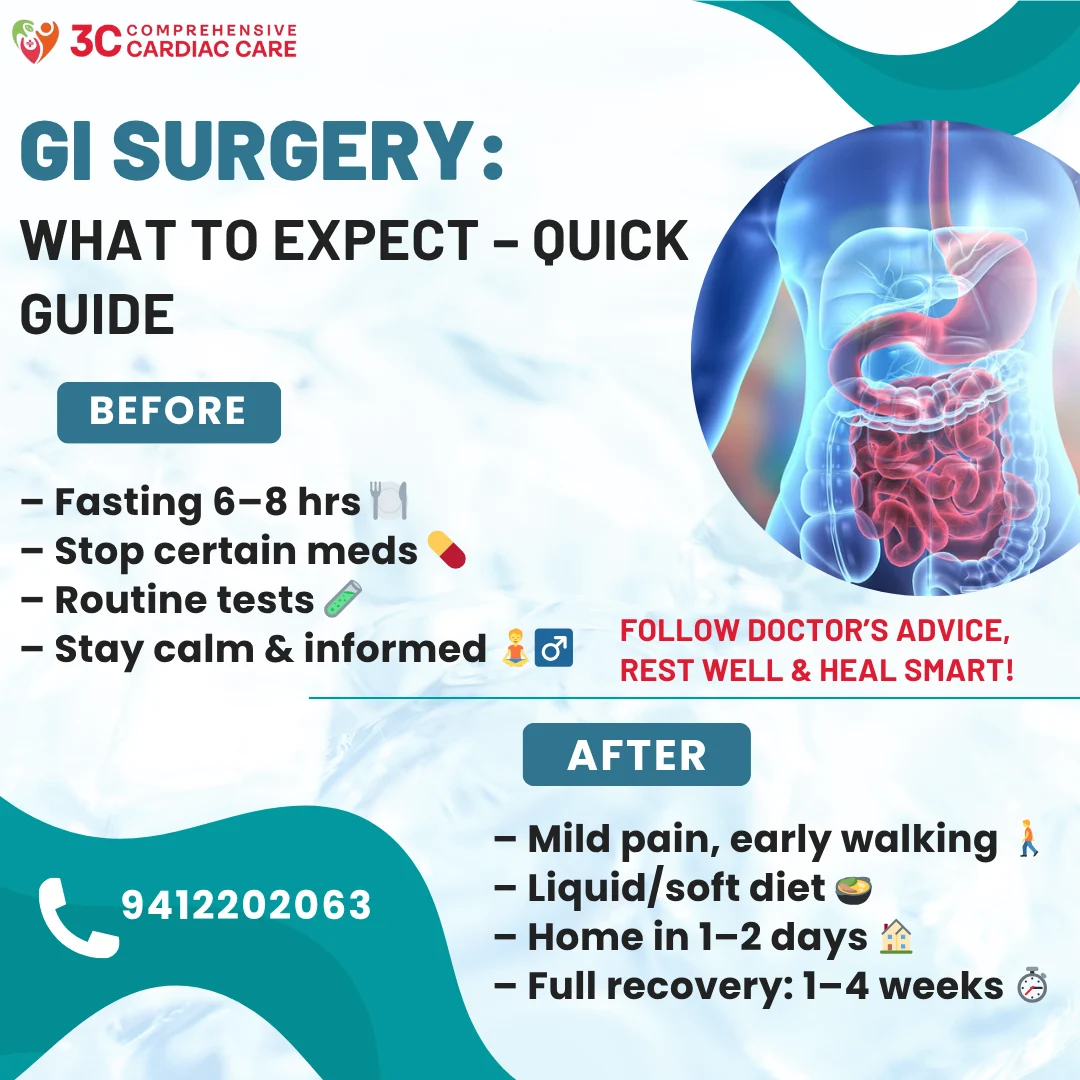
🩺 GI Surgery: What to Expect – Quick Guide
🔹 Before:
– Fasting 6–8 hrs 🍽️
– Stop certain meds 💊
– Routine tests 🧪
– Stay calm & informed 🧘♂️
🔹 After:
– Mild pain, early walking 🚶
– Liquid/soft diet 🍲
– Home in 1–2 days 🏠
– Full recovery: 1–4 weeks ⏱️
✨ Follow doctor’s advice, rest well & heal smart!